
Health Certificates for Rabbits
Are you looking to travel with your rabbit to another state or country? As companion animals, you and your rabbit will have travel requirements to meet, so factor the following into your planning:
Step 1 - Reach Out and Research
Every state and country has requirements for traveling with rabbits, which can change regularly. Look up what requirements you may need to satisfy by consulting all of the following:
Your rabbit’s veterinarian
If you are traveling by plane, your airline’s website
Step 2 - Meeting Travel Requirements
Because every state and country has different requirements, this is not an all-encompassing list but may serve as a starting point for planning purposes. To travel with your rabbit, figure out the following:
Health certificate for travel
A current RHDV2 vaccine and other vaccines as required
Proof they are free of fleas, mites, and intestinal parasites
Microchip number (they may need to be microchipped if they are not currently)
Free of all transmissible diseases such as Pasteurella
The location you are going to
Mode of transportation
Date of departure and arrival
If traveling by plane, whether your rabbit(s) will be traveling alone, as cargo, or with a person in the cabin of the plane
Any stops in states or countries that are not your final destination
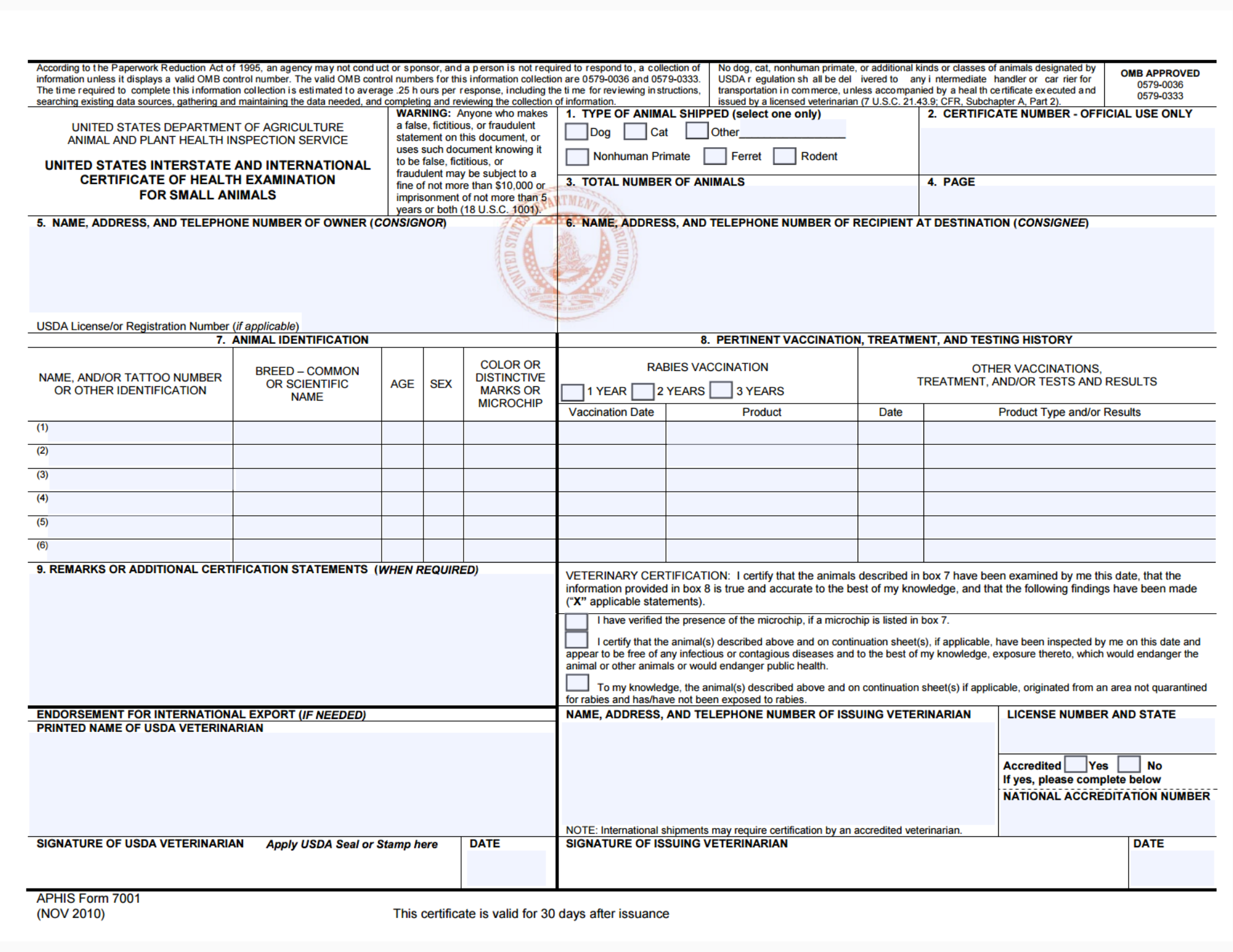
What is a health certificate?
A health certificate is required when traveling to another state or country with a companion animal, including rabbits. The one required item most seem to agree on is a CVI (Certificate of Veterinary Inspection), otherwise known as a health certificate. Among other requirements for travel, health certificates take time to obtain, so if you have travel coming up, it’s essential to contact your veterinarian early in the planning process and discuss how you and your pet can meet these requirements.
You must contact a USDA-accredited veterinarian to obtain a health certificate for your rabbit(s). This veterinarian has gone beyond typical licensing requirements and gone through the additional requirements presented by the USDA. Not all veterinarians are accredited and not all USDA-accredited veterinarians will do international health certificates. Ask your regular DVM if they are accredited and can generate your required health certificate. If not, the APHIS USDA website has a vet search to help you find one.
Step 3 - Prepare for Travel
Once you have all your travel locations, dates, and requirements taken care of, what about the actual trip? For further tips, check out our “Moving with Rabbits” article. Whether by plane, car, or moving service, we also have several blog posts from many families who have moved with their rabbit(s) and shared how they kept their rabbits comfortable for their journeys.
Wishing Safe Travels
Meeting all travel requirements for your rabbit can take anywhere from a few weeks to a few months, depending on your destination. Once you know you must travel, start working with your veterinarian as soon as possible so your rabbit(s) will be all set to go!